Manufacturing Flow Efficiency Analyzer
Rate your facility's current performance in each of the 7 critical flows on a scale of 1 to 10.
Overall Efficiency Score
Priority Action Plan
Walk into any busy factory floor, and you see machines moving, workers assembling, and boxes shipping out. It looks chaotic, right? But underneath that noise is a precise choreography. If even one part of this dance falls out of step, the whole operation grinds to a halt. That’s why understanding the manufacturing flows isn’t just academic-it’s the difference between profit and loss.
When people ask about the "7 flows of manufacturing," they are usually looking for a framework to map how value moves through a facility. While different industries tweak these slightly, the core principles remain universal. Whether you run a small workshop in Bengaluru or a massive plant in Pune, mastering these flows helps you spot bottlenecks before they cost you money.
The Core Concept: Why Flows Matter
Think of a manufacturing plant as a living organism. Blood (materials) must reach organs (machines), nerves (information) must send signals, and waste must be expelled. If you block an artery, the body suffers. In a factory, blocking a flow creates inventory pile-ups, delayed orders, and frustrated customers.
The goal of modern operations management is not just to make things, but to make them smoothly. This concept is central to Lean Manufacturing, a methodology that originated at Toyota. The philosophy is simple: eliminate anything that doesn't add value. To do that, you first need to see what’s actually flowing through your doors.
What is the primary purpose of mapping manufacturing flows?
The primary purpose is to visualize every step from raw material intake to final product delivery. This visualization helps identify bottlenecks, reduce waste, and improve overall operational efficiency by ensuring that materials, information, and resources move without unnecessary delays.
1. Material Flow: The Physical Movement
This is the most obvious flow. It starts when raw materials enter your warehouse and ends when the finished good leaves the dock. Material flow includes everything physical: steel sheets, plastic pellets, electronic components, or food ingredients.
Inefficient material flow looks like backtracking. Imagine a worker picking up a part from Station A, walking past Station B, going to Station C, then having to walk all the way back to Station B because the layout was poorly designed. This wasted movement adds time and labor costs without adding value to the product.
To optimize this, many factories use Value Stream Mapping (VSM). This tool draws out the current state of material movement and highlights where items sit idle. For example, if raw materials sit in a staging area for three days before being processed, that’s a flow interruption. The ideal state is continuous flow, where materials move directly from one process to the next with minimal waiting.
2. Information Flow: The Nervous System
You can have perfect material flow, but if your information flow is broken, you’re flying blind. Information flow refers to data moving between departments, systems, and people. This includes purchase orders, production schedules, quality reports, and customer feedback.
Consider a scenario where sales closes a big deal on Monday. If that order information doesn’t reach the procurement team until Wednesday, and production doesn’t see it until Friday, you’ve already lost four days. In today’s fast-paced market, that delay can mean missing a delivery window entirely.
Modern factories rely on Enterprise Resource Planning (ERP) systems to synchronize this flow. These software platforms ensure that when a sale is made, inventory levels update automatically, and production plans adjust accordingly. Without digital integration, information often gets stuck in silos-sales knows one thing, while the shop floor knows another.
3. Production Flow: The Transformation Process
Production flow is where the actual magic happens. It’s the sequence of steps that transforms raw inputs into finished goods. This flow must be balanced. If Machine A produces 100 units per hour, but Machine B can only handle 50, you create a bottleneck at Machine B. The excess output from Machine A piles up as Work-in-Progress (WIP) inventory, tying up cash and space.
Balancing the line is critical. You need to calculate the takt time-the rate at which you must produce to meet customer demand. If your takt time is one unit every minute, but your assembly station takes two minutes, you’ll fall behind. Conversely, if it takes 30 seconds, you might be overproducing, creating waste.
Lean principles emphasize pull systems here. Instead of pushing products down the line based on forecasts, you pull them based on actual demand. This reduces the risk of overproduction, which is considered the worst form of waste in Lean methodology.

4. Cash Flow: The Financial Pulse
Many manufacturers forget that money is also a flow. Cash flow in manufacturing involves paying suppliers for raw materials, covering labor costs, managing overhead, and eventually collecting payment from customers. If your cash flow stops, the factory stops, regardless of how efficient your other flows are.
A common trap is high inventory holding costs. If you buy too much raw material upfront, your cash is tied up in warehouses instead of being available for payroll or R&D. Similarly, if your accounts receivable cycle is too long, you’re financing your customers’ businesses rather than growing your own.
Optimizing cash flow means aligning it with production cycles. Just-in-Time (JIT) inventory strategies help here by reducing the amount of capital locked in stock. By ordering materials only when needed, you keep cash liquid and reduce storage costs.
5. Human Resource Flow: People and Skills
Machines don’t run themselves. Human resource flow refers to how workers move through roles, how skills are developed, and how labor is allocated. In a rigid factory, a machine operator might only know how to run one specific press. If that person calls in sick, production halts.
Cross-training employees creates flexibility. When workers can operate multiple machines or perform different tasks, the human resource flow becomes resilient. This also boosts morale, as employees feel more valued and less monotonous in their work.
Additionally, consider the flow of knowledge. When experienced workers retire, does their expertise leave with them? Documenting standard operating procedures (SOPs) and mentoring programs ensure that institutional knowledge flows to new hires, maintaining consistency and quality.
6. Energy Flow: Power and Utilities
Energy is often an overlooked flow, but it’s a major cost driver. Energy flow includes electricity, gas, water, and compressed air used to power machinery and maintain environmental conditions. In energy-intensive industries like steel or chemical manufacturing, optimizing this flow can save millions.
Monitor energy usage patterns. Do machines run at full capacity during peak tariff hours? Can you shift non-critical processes to off-peak times? Many factories install smart meters to track real-time energy consumption. This data helps identify inefficient equipment or leaks in compressed air systems, which are surprisingly common sources of waste.
Sustainability initiatives also tie into energy flow. Reducing energy waste lowers carbon footprints, which is increasingly important for regulatory compliance and brand reputation. Governments in India, for instance, offer incentives under schemes like the Perform, Achieve, and Trade (PAT) program for energy-efficient improvements.
7. Waste Flow: Disposal and Recycling
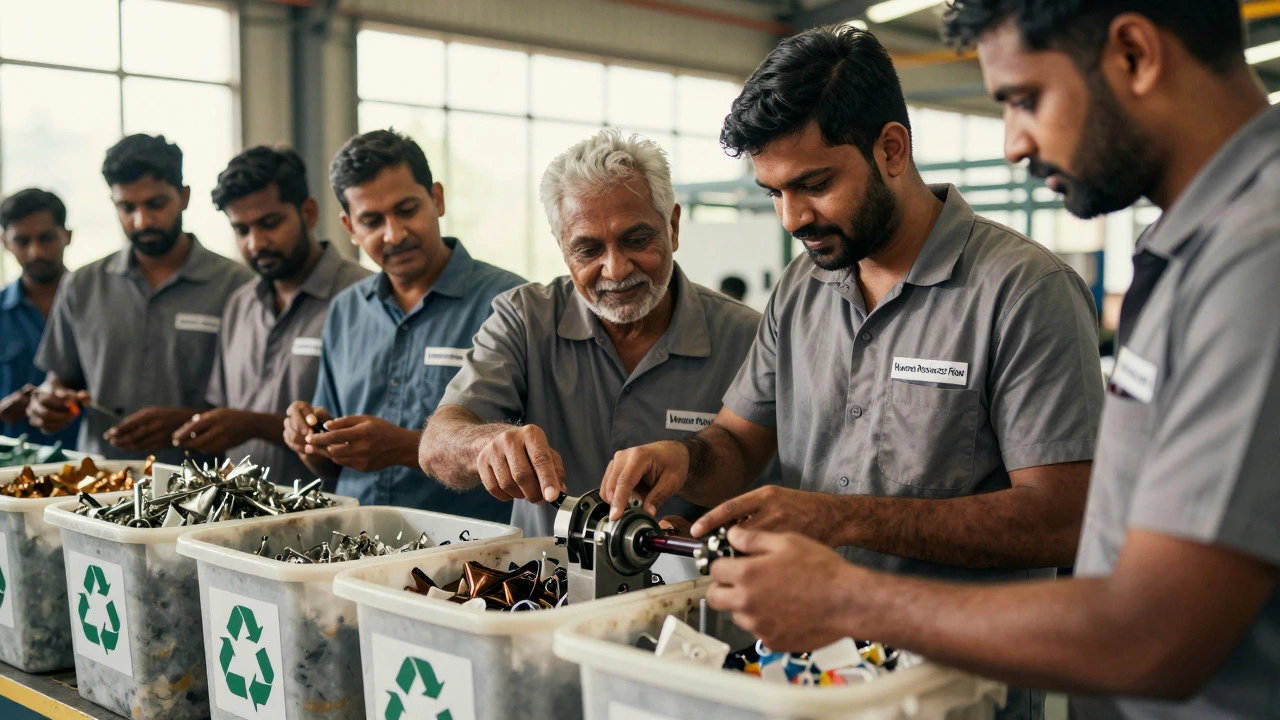
Every manufacturing process generates waste-scraps, defective parts, packaging, or chemical byproducts. Waste flow is how you manage this output. Poor waste management leads to cluttered floors, safety hazards, and environmental fines. Good waste management turns liabilities into opportunities.
Start with source reduction. Can you design the product to use less material? Can you improve precision to reduce scrap rates? Then, focus on recycling. Metal shavings can be melted down; plastic offcuts can be granulated and reused. Even organic waste from food processing can be converted into compost or biogas.
Finally, ensure proper disposal for hazardous materials. Compliance with local environmental regulations is non-negotiable. Tracking waste flow helps you audit your environmental impact and identify areas for circular economy practices, where waste from one process becomes input for another.
Integrating the Flows for Maximum Efficiency
These seven flows don’t exist in isolation. They interact constantly. A breakdown in information flow causes a backup in material flow, which stalls production flow, disrupts cash flow, frustrates human resources, increases energy waste, and generates more physical waste. It’s a domino effect.
To manage this complexity, adopt a holistic view. Use dashboards that integrate data from ERP systems, IoT sensors on machines, and financial records. This gives you a real-time pulse on all seven flows. Regularly review performance metrics like Overall Equipment Effectiveness (OEE), which combines availability, performance, and quality to give a single score of production health.
Start small. Pick one bottleneck-perhaps the handoff between procurement and production-and fix it. Measure the improvement. Then move to the next. Continuous improvement, or Kaizen, is about making small, incremental changes across all flows over time.
| Flow Type | Key Focus Area | Common Bottleneck | Optimization Strategy |
|---|---|---|---|
| Material Flow | Physical movement of goods | Poor layout causing backtracking | Value Stream Mapping |
| Information Flow | Data and communication | Siloed departments | ERP Integration |
| Production Flow | Transformation steps | Unbalanced line speeds | Takt Time Alignment |
| Cash Flow | Financial transactions | High inventory costs | Just-in-Time Inventory |
| Human Resource Flow | Labor and skills | Lack of cross-training | Multi-skilling Programs |
| Energy Flow | Power and utilities | Peak hour usage | Smart Metering & Scheduling |
| Waste Flow | Disposal and recycling | High scrap rates | Source Reduction & Recycling |
Conclusion: Mastering the Dance
Understanding the 7 flows of manufacturing gives you a roadmap to operational excellence. It shifts your perspective from fixing individual problems to seeing the entire system. When you optimize these flows, you don’t just make products faster; you build a resilient business that can adapt to market changes, reduce costs, and deliver consistent quality.
Remember, perfection is not the goal. Continuous improvement is. Start by mapping your current flows, identify the biggest leaks, and plug them one by one. Your competitors are doing the same. The ones who master these flows will win.
How do I start mapping my manufacturing flows?
Begin with a Gemba Walk. Go to the shop floor and observe the actual process without interfering. Sketch a rough diagram of how materials, people, and information move. Identify where items wait, where people backtrack, and where decisions get delayed. This visual map is your baseline for improvement.
Which flow is most critical for small businesses?
For small businesses, Cash Flow and Information Flow are often the most critical. Limited capital means you can’t afford large inventories, so tight control over cash is vital. Additionally, clear communication ensures that limited staff can adapt quickly to changes without confusion.
Can technology automate all seven flows?
Technology can significantly enhance and monitor all flows, but it cannot replace human judgment entirely. ERP systems automate information and cash tracking. IoT sensors monitor energy and production. However, designing the layout for material flow and training humans still require strategic human input.
What is the role of government schemes in improving these flows?
Government schemes like PLI (Production Linked Incentive) or PAT (Perform, Achieve, and Trade) provide financial support for upgrading infrastructure. These incentives can fund the technology needed to optimize energy and information flows, making it easier for manufacturers to implement lean practices.
How often should I review my manufacturing flows?
Review flows quarterly for minor adjustments and annually for major strategic changes. However, if you introduce new products or change suppliers, conduct an immediate review. Continuous monitoring via KPIs allows for real-time tweaks without needing full-scale audits every month.