Manufacturer Status & MSME Eligibility Checker
Step 1: Operational Definition
To be considered a manufacturer, you must transform raw materials into finished goods.
Step 2: Financial Metrics (MSME Criteria)
Enter your financial details to determine your category under the current framework.
Your Assessment
Analyzing...
...
...
You have a workshop. You buy raw materials-maybe steel, fabric, or plastic-and you turn them into something else. A chair, a shirt, or a component for a machine. Is that enough to call yourself a manufacturer? Or are you just a trader who does some light assembly?
This question isn't just semantic. It determines your taxes, your eligibility for government subsidies, and how banks view your loan applications. In India, the line between a 'trader' and a 'manufacturer' is drawn by specific legal and operational definitions. If you are starting a small-scale operation, understanding this distinction is your first real step toward building a compliant, scalable business.
The Core Definition: Transformation of Value
At its simplest level, a manufacturer is an entity that transforms raw materials into finished goods through mechanical, chemical, or manual processes. The key word here is transformation. If you buy rice and sell it, you are a trader. If you buy paddy, clean it, mill it, package it, and sell it as branded rice, you are a manufacturer.
In the context of Indian law, specifically under the Goods and Services Tax (GST) regime, manufacturing is defined as any process involving production or manufacture of (including the manner of finishing or packaging of) an article or thing on which tax has not been levied or will not be levied. This means even final packaging can qualify as manufacturing if it changes the nature of the product for commercial sale.
However, simply changing the form isn't always enough. The transformation must add significant value. Gluing two pre-made parts together might be considered 'assembly' rather than manufacturing, depending on the complexity. For example, assembling a computer from imported components is often treated differently than casting aluminum to create a car part from scratch. The degree of processing matters.
The MSME Framework: How India Classifies Manufacturers
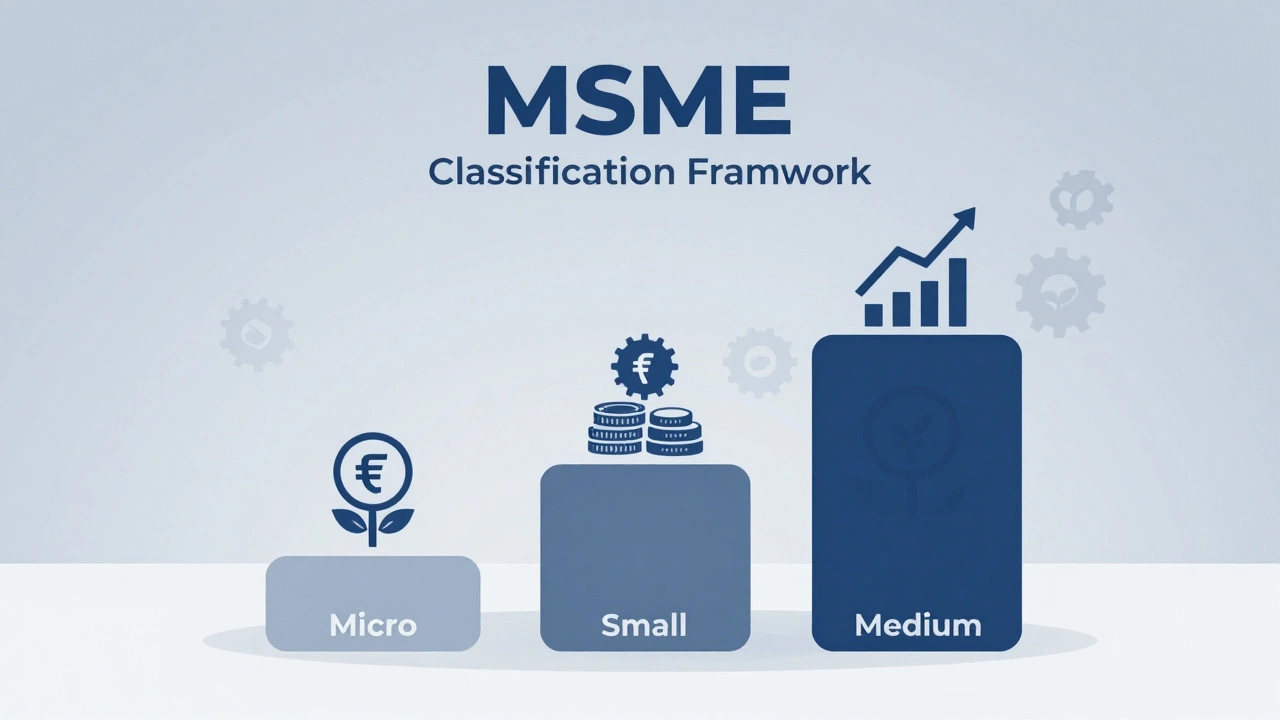
If you are operating in India, the most relevant framework for defining your status is the Micro, Small, and Medium Enterprises (MSME) classification. As of 2026, this classification is based on two metrics: investment in plant and machinery/equipment and annual turnover. This replaced the older classification system that relied heavily on employment numbers, making it easier for automated small businesses to qualify.
| Category | Investment Limit | Turnover Limit |
|---|---|---|
| Micro Enterprise | Up to ₹1 Crore | Up to ₹5 Crore |
| Small Enterprise | Up to ₹10 Crore | Up to ₹50 Crore |
| Medium Enterprise | Up to ₹50 Crore | Up to ₹250 Crore |
To qualify as a manufacturer under this scheme, you must register via the Udyam Registration Portal. During registration, you declare your principal activity. If your primary activity involves manufacturing, you are legally recognized as such. This registration is free, online, and self-declared, but it carries legal weight. It opens doors to priority sector lending, subsidy schemes like PMEGP, and protection against delayed payments from large buyers.
Key Operational Indicators of Manufacturing
Beyond paperwork, what does a manufacturing unit actually look like? Regulatory bodies and auditors look for specific operational indicators to distinguish manufacturers from traders or service providers.
- Physical Infrastructure: Do you have a dedicated space equipped with machinery, tools, or workbenches designed for production? A home kitchen used for baking cakes for sale is different from a commercial bakery with ovens and mixers. The presence of specialized equipment is a strong signal.
- Raw Material Inventory: Manufacturers hold stock of inputs (raw materials) and outputs (finished goods). Traders typically only hold finished goods. If your inventory ledger shows distinct categories for 'inputs' and 'outputs,' you are likely manufacturing.
- Bill of Materials (BOM): This is a critical document. A BOM lists every part, component, and material required to build a product. If you maintain a BOM, you are managing a manufacturing process. Traders do not use BOMs; they use purchase orders and sales invoices.
- Value Addition: Your selling price should significantly exceed the cost of raw materials plus basic logistics. If you buy a widget for ₹100 and sell it for ₹105, you are trading. If you buy raw plastic for ₹50, mold it, paint it, and sell the toy for ₹300, you are manufacturing.
GST Implications: Why the Label Matters
Getting your classification right affects your GST filing. Under GST, manufacturing activities attract different treatment compared to trading. For instance, if you manufacture goods, you may need to comply with additional compliance requirements such as maintaining detailed records of input consumption versus output production.
Furthermore, certain states offer exemptions or lower rates for specific manufactured goods, especially those aligned with Make in India initiatives. If you are incorrectly classified as a trader, you might miss out on these benefits. Conversely, if you claim to be a manufacturer without meeting the criteria, you risk penalties during audits. The Income Tax Department also scrutinizes high-margin businesses claiming manufacturing status to ensure they aren't just inflating costs to reduce taxable income.
Common Misconceptions About Manufacturing Status
Many aspiring entrepreneurs fall into traps when defining their business model. Here are three common myths:
Myth 1: "I don't own a factory, so I'm not a manufacturer." False. Contract manufacturing is widely accepted. If you design a product and hire another unit to produce it using your specifications and branding, you are still considered the brand owner and often the manufacturer for regulatory purposes, provided you control the quality and design. However, the actual production unit must also be registered as a manufacturer.
Myth 2: "Assembly doesn't count." Not entirely true. Simple assembly might not qualify for all subsidies, but complex assembly definitely counts. Putting together electronics, furniture, or vehicles involves significant technical skill and value addition. The key is whether the assembled product has a new identity and function compared to its individual parts.
Myth 3: "Home-based businesses can't be manufacturers." Incorrect. Many MSMEs start from homes. As long as you meet the investment and turnover criteria and follow local municipal laws regarding noise, pollution, and zoning, you can register as a manufacturer. Artisans, craft makers, and small food processors often operate from residential spaces initially.
Steps to Officially Qualify as a Manufacturer
If you are ready to formalize your status, here is the practical path forward:
- Define Your Process: Document how raw materials become finished goods. Create a simple flowchart. Identify where value is added.
- Register Your Business: Choose a structure (Proprietorship, LLP, Pvt Ltd). Register for GST. Ensure your GST application lists 'Manufacturing' as your primary activity code (HSN/SAC codes).
- Obtain Udyam Registration: Visit the Udyam portal. Use your Aadhaar or PAN to verify your identity. Select 'Manufacturing' as your industry type. Fill in details about your investment and projected turnover.
- Comply with Local Laws: Check with your local municipal corporation for trade licenses. If your process involves chemicals, heavy machinery, or waste disposal, you may need consent from the State Pollution Control Board (SPCB).
- Maintain Records: Keep separate accounts for raw material purchases and finished goods sales. Use accounting software that supports inventory management for manufacturing.
Why This Distinction Drives Growth
Being officially recognized as a manufacturer unlocks capital. Banks prioritize lending to MSME manufacturers because they are seen as job creators and contributors to GDP. Government schemes like the Credit Guarantee Fund Trust for Micro and Small Enterprises (CGTMSE) provide collateral-free loans specifically to registered MSMEs.
Additionally, many large corporations prefer sourcing from certified small-scale manufacturers to diversify their supply chains and support local economies. Having a valid Udyam certificate and GST registration signals professionalism and compliance, making you a more attractive partner.
So, do you qualify? If you transform materials, add value, and operate within the defined financial limits, you likely already are a manufacturer. The only missing piece might be the paperwork. Start there, and let your official status fuel your growth.
Can a home-based business register as a manufacturer in India?
Yes, absolutely. Home-based businesses can register as manufacturers under the MSME framework via Udyam Registration. However, you must ensure your activity complies with local municipal laws regarding noise, pollution, and zoning restrictions. Certain hazardous processes may require additional clearances from the Pollution Control Board.
What is the difference between a trader and a manufacturer for GST purposes?
A trader buys finished goods and sells them without altering their form. A manufacturer transforms raw materials into finished goods. For GST, this affects your HSN codes, input tax credit claims, and potentially your eligibility for state-specific exemptions. Manufacturers must maintain detailed records of input consumption and output production.
Do I need a factory license to be a manufacturer?
Not necessarily. The requirement depends on the size of your operation and the number of employees. Small units with fewer workers and low power consumption may not need a Factory License under the Factories Act. However, you will still need a Trade License from your local municipality and possibly environmental clearances depending on your process.
Is assembly considered manufacturing?
Complex assembly is generally considered manufacturing, especially if it adds significant value and creates a product with a new identity. Simple assembly of pre-fabricated parts might be classified differently. The key factor is the degree of transformation and value addition involved in the process.
How does Udyam Registration help small manufacturers?
Udyam Registration provides legal recognition as an MSME. Benefits include access to priority sector lending, protection against delayed payments from buyers, eligibility for various government subsidy schemes, and reduced interest subvention on loans. It is a crucial step for accessing institutional support.